Excellent 5 out of 5
Web applications have seen massive adoption across several business domains. From interactive features to static web pages, web applications have come a long way, resembling a mobile application.
While faster mobile applications provide native capabilities, they are required to be updated regularly. Web applications, on the other hand, update automatically where users can access them without installation. Hence, it makes web applications an attractive option for several organizations.
Web application development needs great planning, the right framework, and a reliable structure. Furthermore, to reap the maximum benefits of a browser-based experience and to offer a consistent user experience, it is essential to consider all the aspects of the development lifecycle. So, let us find more and discuss the web application development process, its types and stages, frameworks, and development cost.
What is a web application?
A web application or a web app is a computer program that runs on the browser to execute certain functions. It communicates with the server-side for transforming the data through an AJAX, HTML, or API request.
A web application has two major parts, namely, client-side and server-side. The server-side scripts are used by the apps to store and retrieve data. Further, it uses client-side scripting to present data in the user interface received through a server-side script.
Difference Between a Web Application and Mobile Application
To offer interactive functionalities, mobile applications require native environments of a specific mobile device for operations. On the other hand, websites focus on presenting information through web pages. Thus, the combination of both a mobile application and a website forms a web application.
Unlike mobile applications, a web application doesn't require any native environment for operations. Additionally, it doesn't follow a read-only content structure like websites. Web applications provide more information as compared to websites and offer the interactive experience of mobile apps.
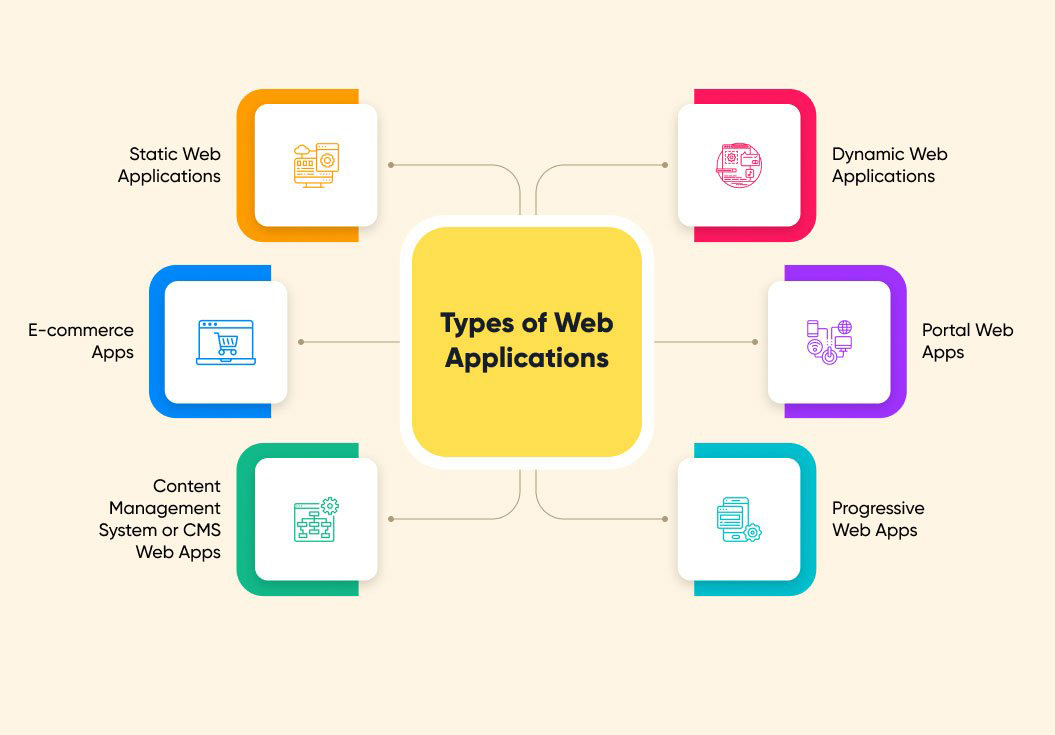
Types of Web Applications
Every type of web application has different functionality and differs in terms of their interaction with the server that sets them apart.
1. Progressive Web Applications (PWAs)
PWA is a single solution-based web application catering to more than one platform and offers a mobile app-like experience through improved web capabilities.
Web browser and server are the two layers that can be found in PWAs. In a standard web application structure, a server-side and client-side interact with each other through AJAX. However, PWAs add progressive enhancements through a service worker where caching is used to facilitate online features. In addition, it helps in using specific features natively without the internet.
2. Single Page Applications (SPAs)
Browser-based applications, SPAs, need not be reloaded for displaying content on a certain page. The entire structure is split into server-side and client-side that communicate via API requests(AJAX). The server-side takes care of the database with the third-party services, and the client-side deals with the user interface through the browser.
SPA has a presentation layer that executes on the end of a browser. Additionally, any changes within SPA data are made in the business layer by the business logic.
3. Multi-Page Applications (MPAs)
MPAs have a complex structure with several pages linked with each other. These conventional web applications are required to be reloaded to display the changes in a page. Whenever a user requests data exchange, a new page is displayed on the browser from the server.
Multi-Page Applications have pages with static content and internal linking, which provides a multi-layered interface. With a hierarchy of pages and several internal links, indexing becomes much easier for search engines.
4. Static Web Applications
Static web applications display content that is not interactive or flexible. They are developed using HTML, jQuery, CSS, and AJAX. Though static in characteristics, these web applications allow animated elements, gifs, banners, and videos to make an app aesthetically pleasing.
However, these inclusions need altering the HTML code, adjusting it, and then sending it back to the server for execution. It all takes a lot more time and is a tedious task.
5. Dynamic Web Applications
Dynamic web applications are complex in structure. A database is used to load data, and each time a user accesses the app, the content gets updated. A central admin panel makes content modifications according to the user's request.
Implementing features in dynamic web applications is easier as there is no need to get access from the server to reflect changes. Additionally, different programming languages such as PHP and ASP.NET can be utilized to develop dynamic web applications.
6. eCommerce Web Applications
eCommerce web apps are usually an extension of MPAs. However, these web apps are dynamic and support advanced features such as shopping carts, online payments, real-time delivery tracking, etc.
7. CMS Web Applications
CMS web apps are designed to create, modify and manage website content without expertise in programming languages. In addition, there are tools that help make changes in web apps.
So now that you have learned about the different types of web applications, let us find tools that can be used to develop them. Web app development frameworks help with excellent features and pre-built tools.
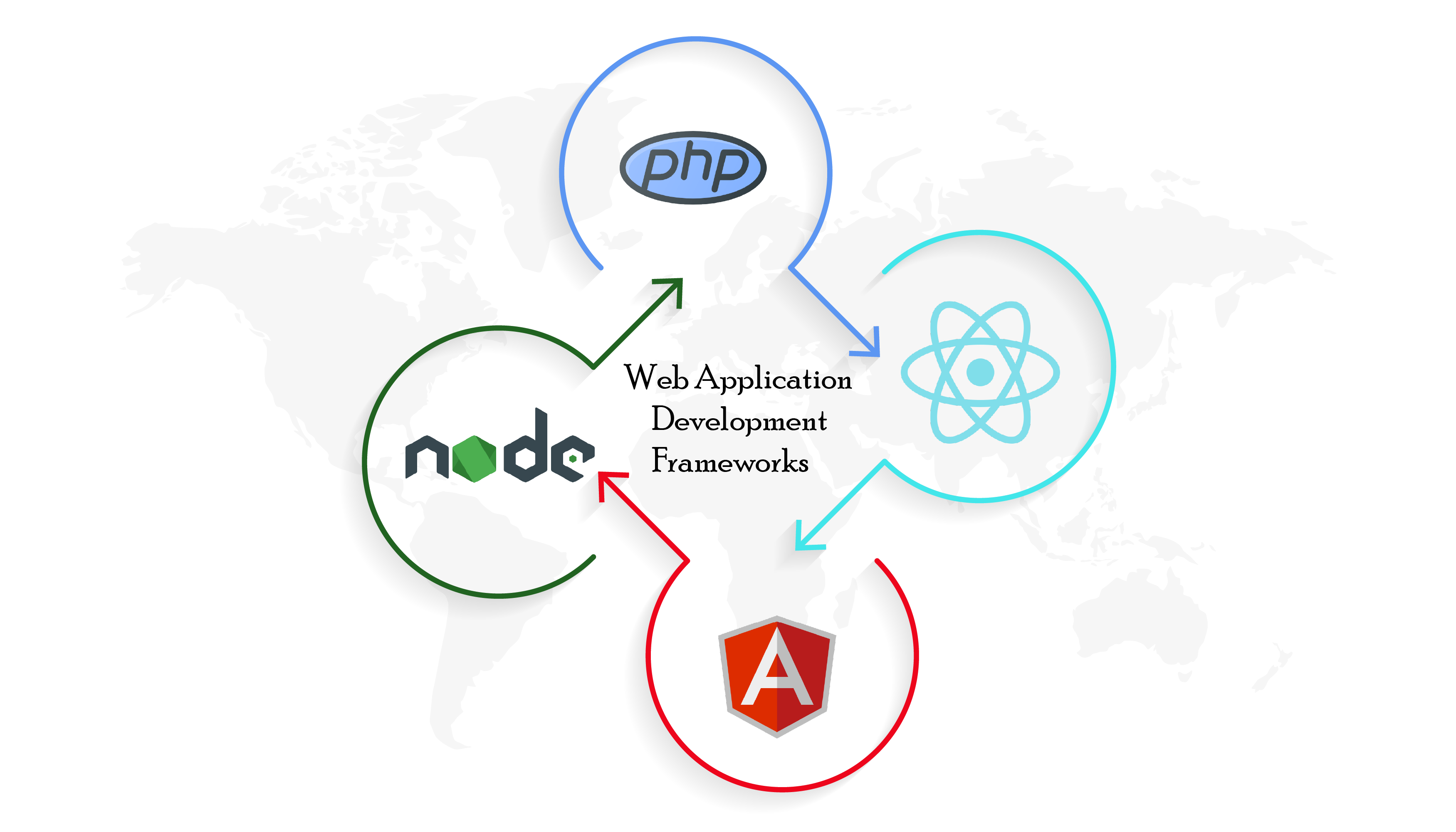
Web Application Development Frameworks
Besides a suite of tools, a web application development framework offers pre-written codes or scripts for specific functions. Also, some of these frameworks have massive libraries that can be used for the web app development process.
1. PHP
PHP, also known as hypertext preprocessor, is an HTML-embedded scripting language. It helps in developing dynamic web apps by combining the Common Gateway Interface (CGI) with an HTML document. It is compatible with database tools, including Oracle, MySQL, etc., and can easily embed HTML codes.
2. Node.Js
Node.Js is an open-source and phenomenal framework, offering high-performance and scalability through async programming. It is a Javascript-based runtime environment that provides server-side capabilities. Additionally, several Node.Js-based frameworks can be used to enhance the back-end capability of a web application.
3. Angular
Angular provides reusable codes across multiple deployment platforms. It is a typescript-based frontend framework with several in-built tools and libraries. It helps in developing scalable web applications of any scope or size.
4. React.JS
React.JS is an extensive library with ready-made components. It is an open-source front-end Javascript library offering the flexibility of creating reusable components and helps in building rich user interfaces.
Web Application Development - Stages
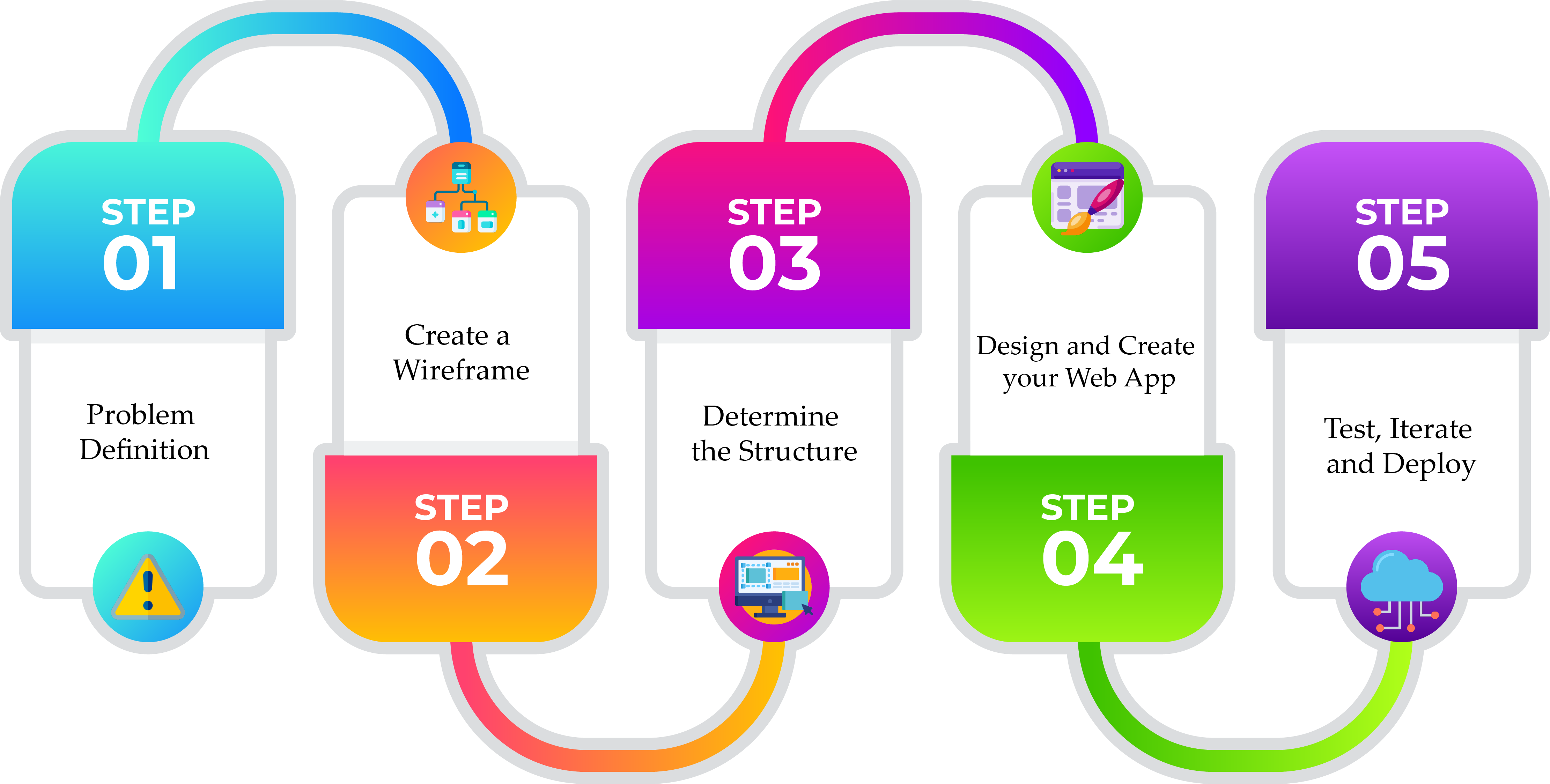
There are several stages for web application development that includes problem definition, developing a wireframe, building, and deployment. In addition, a reliable strategy is required to execute an excellent web application. So consider the following process and stages for your web application project
1. Problem Definition
Web development apps are generally created to solve the problems of the audience. Hence, it is vital to determine a problem that depends on the customer needs, their pain points, and the market. The problem can be defined through Big data, online surveys, and analytics.
2. Create a Wireframe
Building a wireframe of the entire web development process helps in planning on different aspects such as tools, resources, frameworks, and testing requirements. It also enables laying down the development process and approach.
3. Determine the Structure
Every web app is a multi-layered architecture, and it is the backbone that enables the system to respond efficiently to user requests. The presentation layer, business layer, data access layer, and data service layer function independently without bearing the burden of the function executed in other layers. Thus, it allows achieving scalability and better performance without disruptions.
4. Design and Create your Web App
The designing and development of web apps begin with a wireframe of the entire interface. It helps understand critical touchpoints and enables visualization of user experience to determine how to improve it.
While designing, it is vital to take care of your target audience and define navigational features such as sidebars, menus, toolbars, CTAs, buttons, etc. In addition, make sure that your design is responsive for different screen sizes.
5. Test, Iterate and Deploy
Testing before deployment allows the developers to make the subsequent iterations quickly. In addition, quality assurance ensures the high performance of web applications.

The Cost of Developing Web App Development
While estimating the cost of web app development is a difficult task. However, it is also an essential aspect that must be considered when planning to develop web applications.
The overall costs of developing a web app depend on the complexity of features. Simple features such as logins, social sharing buttons, and navigational functions do not need extensive knowledge and, as a result, lessens the cost of development. However, advanced features like data analytics, 3D, animations, Artificial Intelligence(AI), and Machine Learning need an experienced developer. You can contact the expert developers at GeekyBones.
Conclusion
Web applications offer interactive experiences, and hence they have picked up the pace these days. Therefore, in this competitive era, it is vital to go beyond conventional approaches to benefit from web application development.
So, get ready for web application development and achieve your business goals.




GeekyBones is a trusted technology leader with a team of highly skilled professionals who take care of business in every aspect. Our passionate experts offer software, web and mobile application development for several industries. Establish a solid identity in the marketplace with our uniquely created expertise.
Get In Touch With Us
 +91 9478511189
Plot No 986, Ground Floor, Sector 82, JLPL Industrial Area, Sahibzada Ajit Singh Nagar, Punjab 160055
 contact@geekybones.com
